
Our work has been featured in a variety of news stories over the years
Featured Stories
-

Behind the Scenes with Collections at The Emily Dickinson Museum
This recorded webinar was the first in a three-part series exploring the collection of The Emily Dickinson Museum. Head Conservator Carolyn Frisa was one of several conservation consultants that helped the museum complete a three-year collections documentation project funded by the Institute for Museum and Library Services. In this series, Museum staff converse with specialists and conservators about the unique qualities, challenges and opportunities of this singular collection. Featured guest: Carolyn Frisa, head conservator and owner of Works on Paper conservation studio.
-

Conserving First Lady Edith Wilson's Driver's Permit
In this video, Head Conservator Carolyn Frisa discusses the process undertaken to bring First Lady Edith Wilson's original Automobile Operator's Permit back to life. Edith Bolling Galt Wilson became the first documented woman to drive an electric car in Washington D.C. on September 7, 1904. This artifact was on the list of Virginia's Top 10 Endangered Artifacts in 2017. Grant funding from the program allowed for the document's conservation.Description goes here
-

Curtains without Borders Project at the Rhode Island Historical Society
Head Conservator Carolyn Frisa is a member of Curtains without Borders, a non-profit organization made up of multi-discipline conservation professionals dedicated to documenting and preserving historic painted scenery. She works with the team on several projects in New England and beyond each year. This story in the Rhode Island Historical Society Member Newsletter features the conservation of the oldest theater curtain she has treated, dating all the way back to about 1810.
-

Conserving a 1939 Drawing of North Creek's Snow Train
We worked with the North Creek Depot Museum to conserve an important piece of early ski history in North Creek, NY. The conservation of this drawing by Dorothea C. Loewel was celebrated with an event that is the first in a series commemorating the 90th anniversary of their famous Snow Train.
-

Flood Response in Vermont, July 2023
The summer of 2023 brought another year of devastating floods to Vermont. As part of her work with VACDaRN (The Vermont Arts & Culture Disaster and Resilience Network), Head Conservator Carolyn Frisa led a volunteer-run relief effort at the Vermont Studio Center and helped several other cultural institutions and members of the public salvage their flood-damaged collections.
-
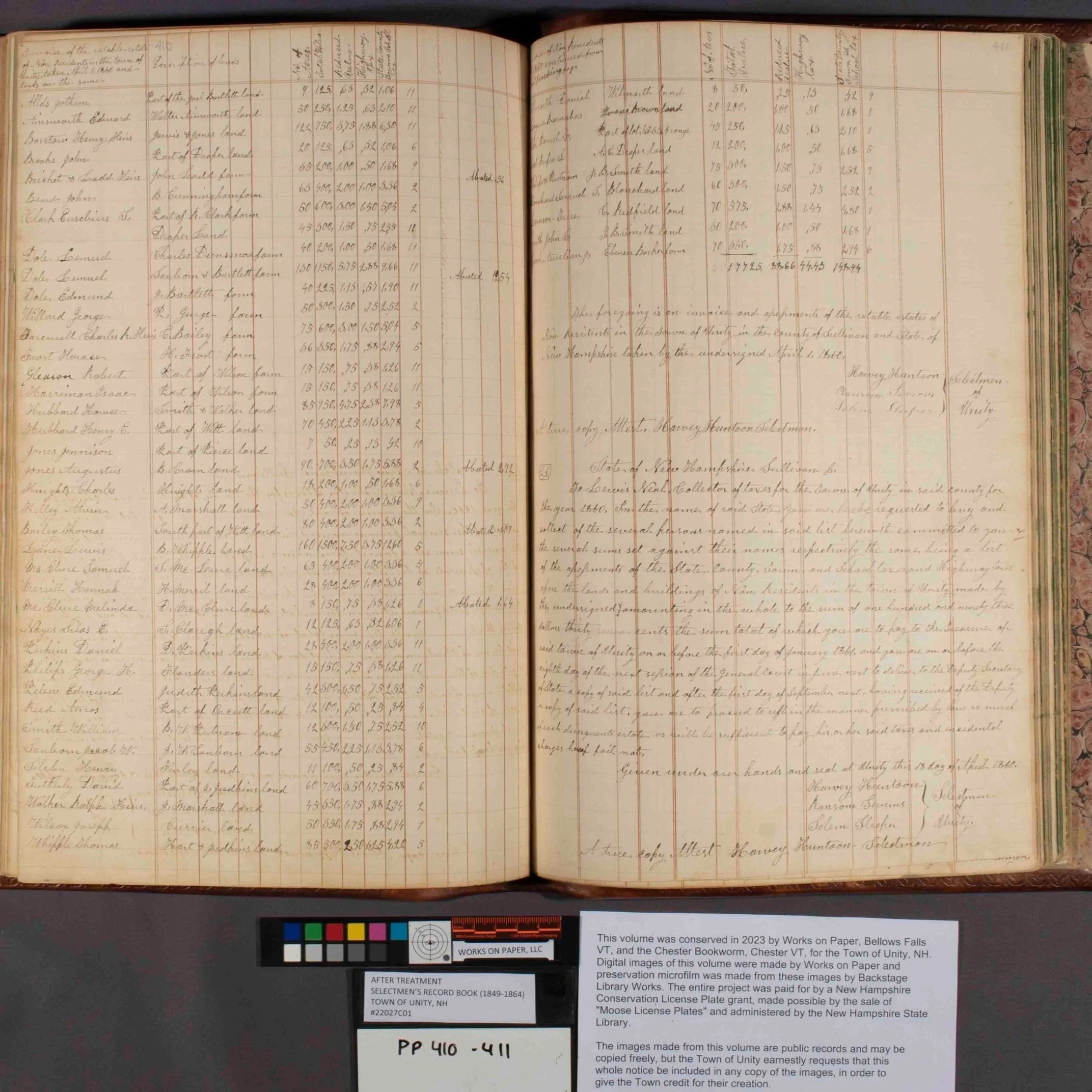
Grant-Funded Conservation of Unity Town Records, 2023
New Hampshire has one of the best state-funded conservation programs in the country. Each year, we work with qualified organizations to help conserve and digitize irreplaceable historic records through the New Hampshire State Library’s Moose Plate Grant Program. New Hampshire, uniquely as far as we know, dedicates a portion of conservation license plate revenue to cultural heritage conservation. We’ve worked with the Town Clerk’s Office in Unity, NH on several of these projects over the years, including this one that we completed in 2023.
-

Conserving Water-Damaged Wallpaper at the Inn at Shelburne Farms
As Julie Elridge Edwards , Curator of Collections at Vermont’s Historic Shelburne Farms, says, “Water leaks and stains are something to be feared in a historic house.” In late June of 2017, staff began noticing a few damp spots on the historic Frederick Beck & Co. wallpaper covering the corridor walls leading to the Main Dining Room. Head Conservator Carolyn Frisa was contacted and performed the work to temporarily remove the damaged sections of wallpaper so they could be treated in our studio before being reinstalled with the help of master paperhanger, John Plant in 2018.
-

Response to Superstorm Sandy in NYC in 2013
Head Conservator Carolyn Frisa has been a member of the American Institute for Conservation’s National Heritage Responders since 2011. She was unable to travel to New York City when Superstorm Sandy hit, but was able to provide guidance to artists over the phone and email throughout the recovery from this catastrophic flooding event. The work of the AIC NHR team was featured in the New York Times.
-

Saving Water-Damaged Items at the Rockingham Free Public Library
Cold Vermont Winters often cause pipes to burst, and this means we usually have a few water-damaged collections at our studio in these cold months. This was the case when a pipe burst above the Historical Collections Room at the Rockingham Free Public Library (just up the street from our studio!) in December of 2010. Our work on this project was featured in a story on Vermont Public (or VPR as it was known at the time of recording).
-

Vermont Arts & Living Magazine Article
Our studio was featured in Vermont Arts & Living Magazine a few years after we opened in 2008.
-

The Artisans Behind the Scenes at the Inn
Carolyn Frisa is head conservator and owner of Works on Paper in southern Vermont, where she specializes in the preservation and conservation of paper. She has helped Shelburne Farms conserve a variety of objects from the collection, including framed photographs, engravings and watercolors, and wallpaper dating to 1890 and 1899.
-

Curtain Time: Historic Jackson drapery restored
Head conservator Carolyn Frisa worked for three days with other conservators from Vermont’s non-profit Curtains Without Borders, to restore a 124-year-old theater curtain at the Jackson Historical Society.
-

Preserving the Bird Residents of Sweet Briar
Head conservator Carolyn Frisa worked to conserve the 1937 bird map of the Sweet Briar College campus.
-
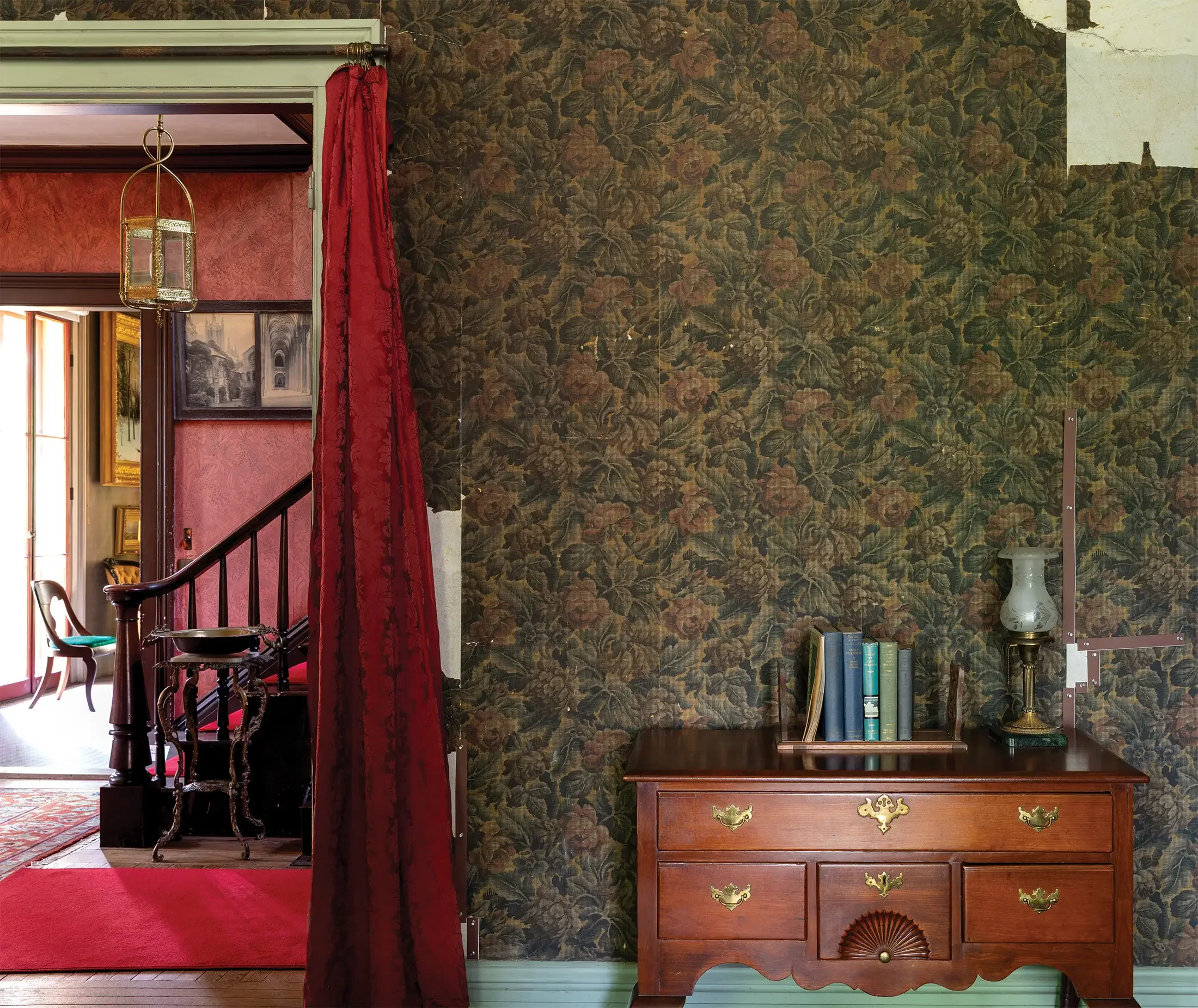
Wallpaper Conservation at the Emily Dickinson Museum
The talents of many different kinds of preservation practitioners are required to produce the desired outcome: historians, preservation architects, materials scientists, engineers, conservators, curators, decorative arts specialists, artisanal wallpaper printers and more.